
Are you passionate about the ocean and its diverse inhabitants? Have you ever been curious about seeing sea turtles up close? Or perhaps you’re interested in seeing what it’s like to care for endangered animals?
If you said “yes!” to any of those, then you’ll definitely want to visit the Turtle Hospital in Marathon, Florida.
Skip the hotels and book a Marathon vacation rental so you can be as close as possible to the turtle action, then read on for more about this unique animal medical center.
What Is The Turtle Hospital?
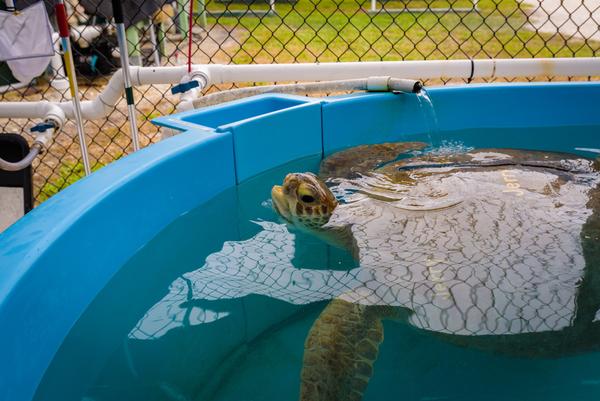
Photo Credit: Roberto La Rosa
Marathon’s Turtle Hospital, a 501(c)(3) nonprofit organization, actively rescues and rehabilitates endangered sea turtles. The organization also promotes regional educational programs, raises awareness for local marine life, and advocates for environmental legislation to help endangered sea turtles.
Richie Moretti founded the Turtle Hospital in 1986, and its mission expanded when Hurricane Wilma caused flooding. This flooding led to renovations of the Hidden Harbor Motel, transforming it instead into a state-of-the-art rehabilitation center for injured turtles.
Today, local volunteers and veterinarians care for both temporary and permanent residents. The facility now features a 100,000-gallon sea turtle aquarium, which houses both permanent residents and turtles preparing for release.
The Turtle Hospital has rehabilitated and released more than 3,000 sea turtles and assisted thousands of disoriented hatchlings. The facility has a full-time team of employees and dedicated turtle ambulances equipped with kayaks and netting.
The hospital often holds public turtle releases that are free to attend. Keep an eye on its website and social media pages for announcements if you want to attend one.
How Does the Turtle Hospital Work?
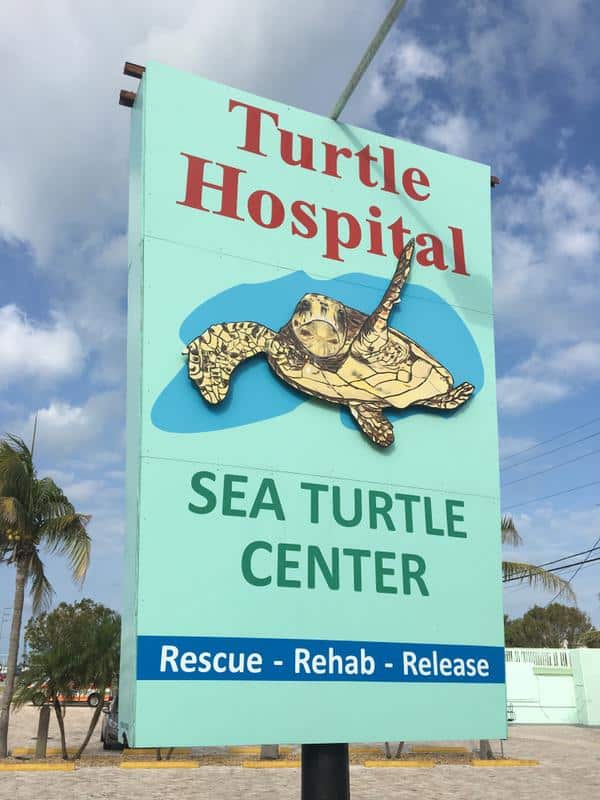
Photo Credit: James Kirkikis
The Turtle Hospital’s approach has three main steps:
- Rescue
- Rehabilitate
- Release
Unlike a traditional aquarium, the turtles you see in the tanks at the hospital are at various stages of this three-step process.
The aim is to keep each turtle for only as long as necessary until they’re fully healed and ready to be released back into the wild. The only exceptions to this rule are the few turtles that reside permanently at the hospital due to conditions that would prevent them from surviving in their natural habitat.
One such turtle was the beloved Bubble Butt, the center’s longest resident, who was rescued after a boat strike in 1989. His positive buoyancy disorder was managed by fitting him with fiberglass counterweights attached to his shell. He passed away in 2022 at age 35, and is still remembered fondly today by the hospital team.
A wide variety of ailments and injuries are treated at the center. Most often, patients are suffering from disease, or boat or fishing line injuries to flippers or shells. Ingestion of trash and buildup of plastics in their stomachs is another common ailment.
The most common surgery performed at the hospital is the removal of fibropapilloma tumors, which affect more than half of the Green sea turtles in the Florida Keys. If left untreated, the tumors can grow large enough to affect a turtle’s movement, so the hospital does important work by removing them.
Turtle Hospital Info: Hours, Pricing, And More
- Address: 2396 Overseas Highway, Marathon, FL
- Hours: 9 AM – 6 PM (last tour begins at 4 PM)
- Website: turtlehospital.org
- Phone: (305) 743-2552
- Tickets: $38 for adults, $19 for children 4–12 years, free for children under 4
Tour tickets can be purchased online.
The Turtle Hospital is located in Marathon, Florida, at mile marker 48.5. If you have aquatically-inclined family or friends, it makes for a great day trip from Miami (2.5-hour drive south) or Key West (1-hour drive north).
It also makes a fun and educational rainy day activity for the kids, as most of the center is covered or indoors. For more educational activities about marine life in Marathon, you can combine your Turtle Hospital trip with a visit to the Dolphin Research Center which is just 15 minutes away.
The Turtle Hospital Education Center and Gift Shop welcomes visitors daily. You must take a guided tour if you want to visit the turtles; they last 90 minutes and run every hour from 9 AM to 4 PM.
Although you can purchase admission at the tour, it’s wise to book in advance because it’s a very popular attraction. You can book your tickets online.
The admission fee includes the full behind-the-scenes educational tour, where you get to explore the receiving room, X-ray room, and operating room. You’ll also enjoy presentations on sea turtle anatomy, their eating habits, and common injuries.
At the end of the tour, you can actually meet and feed the center’s permanent turtle residents yourself.
More Facts About Florida Sea Turtles
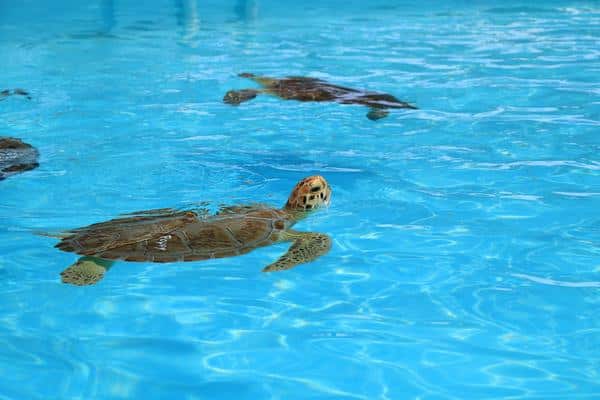
Photo Credit: Daniele Novati
If you love sea turtles, Florida is the place to be. Globally, seven species of sea turtles exist, and five of them live in the Florida Keys alone: the green sea turtle, the hawksbill, the leatherback, Kemp’s ridley, and loggerhead turtles. All of these species are classified as endangered or vulnerable, hence the importance of the hospital.
Here are some more fascinating facts about our marine friends:
- Sea turtles have roamed the Earth’s oceans for millions of years.
- Sea turtles migrate thousands of miles in their lifetime.
- In a single nesting season, females lay between two and six clutches of eggs, each containing 65 to 180 eggs.
- One out of 1,000 hatchlings survives to be an adult.
- Some sea turtles can live for 50 to 100 years.
- Leatherbacks are the largest sea turtle species and can weigh up to 2,000 pounds.
- Sea turtles feast on anything from seaweed to jellyfish.
- Sea turtles can travel up to 22 miles per hour in water.
How You Can Help The Sea Turtles in Marathon?
The residents of the hospital are already being taken care of, but there are still plenty of sea turtles out there that could use a bit more respect and care. During your visit to the Florida Keys, there are many ways you can help the wild sea turtles living in the area:
- Make sure to dispose of all trash properly and recycle whenever possible. Sea turtles often consume or get stuck in our plastic trash!
- If renting a boat in Marathon, keep an eye out for turtles while boating and maintain a safe distance to avoid collisions.
- During nesting season (which occurs from late spring to early summer), be sure to turn off beach-facing lights at night.
- Don’t disturb any nests or hatchlings that are making their way to the sea.
- If you encounter a sick or injured sea turtle, contact the Turtle Hospital’s emergency line at (305) 481-7669, or the Florida Fish and Wildlife Conservation Commission online or at 1-888-404-FWCC.
Dive Deep into Marathon’s Marine Life
Whether you’re passionate about conservation or just curious about seeing a sea turtle up close, a trip to the Turtle Hospital in Marathon is sure to be a unique addition to any trip to the Florida Keys. After all, we should all put in the effort to learn more about the natural world around us, especially in an environment as diverse as the Keys.
Book your stay on Marathon Key today so the turtle hospital is just a stone’s throw away. This is one of the best opportunities to learn about sea turtles in the entire Florida Keys.